
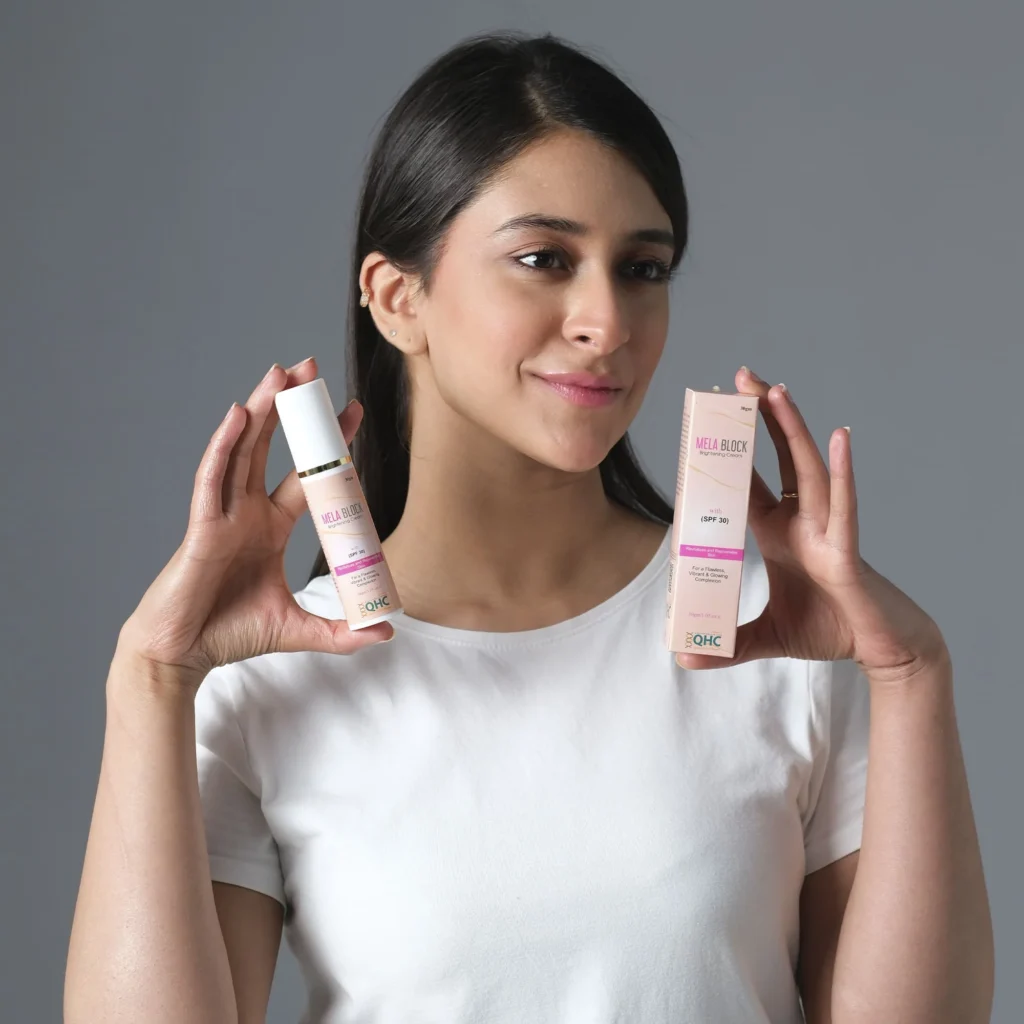
Most of us have a patch of skin that just won’t match the rest. It might be a dark mark from a pimple you picked two years ago, a tan line that never faded, or a cheek that looks a shade deeper than the other. Where does that come from, and what can a cream actually do about it?
QHC Mela Block Brightening Cream contains Alpha Arbutin, Vitamin B3, Kojic Acid, Glutathione, Vitamin E and SPF 30 sunscreen filters. Before getting into what each does, it helps to know how pigmentation forms in the first place.
Where dark spots come from
Your skin colour comes from melanin, which is made by cells called melanocytes. To make it, those cells rely on an enzyme called tyrosinase. When something irritates or stresses the skin, such as sunlight, hormonal shifts, acne or inflammation, the melanocytes can ramp up production. The extra pigment settles in one area and you see a spot.
That’s why a pimple can leave a brown mark long after it’s gone, and why a few weeks of strong sun can make old marks look darker. Each ingredient below works on a different step in this chain.
What’s in Mela Block
Alpha Arbutin slows down tyrosinase. With less enzyme activity, the skin makes less pigment over time. It’s widely used for post-acne marks, sun spots and uneven patches, and people like it because it works without the harsh bleaching effect of older lightening agents.
Niacinamide (Vitamin B3) doesn’t touch melanin production. It stops pigment from being passed along to neighbouring skin cells, so spots look less defined with regular use. It also helps the skin hold on to moisture, which is useful because many brightening ingredients can leave skin a little dry.
Kojic Acid also goes after tyrosinase. It grabs onto the copper the enzyme needs to work, so the enzyme stalls. You’ll mostly see it used for sun-related darkening, freckles and acne marks. It can irritate some skin, so if yours is on the sensitive side, start slowly and see how it reacts.
Glutathione is an antioxidant your body already makes. It mops up free radicals, and it’s been studied for its link to melanin production. The evidence for glutathione applied on the skin is still thin, though, and it shouldn’t be put in the same league as Alpha Arbutin or Niacinamide, which have much more behind them.
Vitamin E is another antioxidant, and a fat-soluble one, which is why it shows up in so many moisturisers. It softens the skin and helps defend it against daily damage from sun and pollution. It won’t fade a dark spot by itself, but it earns its place in the formula.
Why there’s sunscreen in it
You can use the best brightening ingredients in the world and still get nowhere if you spend the day in unprotected sun. UV light switches melanin production back on and darkens the spots you’re trying to fade.
Mela Block has SPF 30, built from three filters:
- Zinc Oxide is a mineral filter that sits on the skin and blocks both UVA and UVB.
- Avobenzone is a chemical filter used mainly for UVA, the rays behind ageing and pigment changes.
- Titanium Dioxide is another mineral filter, strongest against UVB and part of UVA.
How well the finished cream protects depends on its formula and how it was tested, and you only get the labelled protection if you apply enough.
Why the combination matters
Pigmentation isn’t a one-step problem, so one ingredient rarely fixes it. Alpha Arbutin and Kojic Acid cut down on pigment production, Niacinamide limits how far it spreads, the antioxidants protect the skin, and the sunscreen keeps new damage from undoing the progress.
None of this changes your natural skin tone. The goal is to fade the marks and even things out.
How to use it
- Wash your face with a gentle cleanser and pat dry.
- Apply the cream to clean skin, following the directions on the pack.
- Keep it away from your eyes and from any broken or irritated skin.
- If you’re wearing it in the daytime, use enough to get the SPF it promises, and reapply if you’re outside for hours or you’ve been sweating.
- Stick with it. Pigmentation fades slowly, and changing products every few weeks resets the clock.
If your skin is sensitive, try a small patch first, on the jawline or behind the ear.
Who it’s for
Mela Block suits people with:
- Dark marks left by old breakouts
- Uneven skin tone
- Sun-related pigmentation or freckles
- Dull skin
- Mild patches of discolouration
If the pigmentation is stubborn or spreading, or you think it might be melasma, see a dermatologist. Melasma often has hormonal causes and usually needs more than a cream.
The short version
Alpha Arbutin, Niacinamide and Kojic Acid do the main work on pigmentation. Glutathione and Vitamin E back them up, and SPF 30 protects the results. Use it regularly, wear sun protection, and give it a few weeks before judging it. You can expect your existing skin tone to look clearer and more even, not lighter than it naturally is.
Frequently Asked Questions
Which ingredients work best for brightening?
For dark spots and uneven tone, most people look to Alpha Arbutin, Niacinamide and Kojic Acid. They don’t work the same way, so together they cover more than any one of them alone.
How does Alpha Arbutin work?
Melanin can’t be made without tyrosinase, and Alpha Arbutin dials that enzyme down. The skin then makes less extra pigment, and spots lighten gradually.
Can Niacinamide help with dark spots?
It can, just not by the same route. Rather than cutting pigment production, it limits how much pigment moves into the neighbouring skin cells. With regular use, uneven tone looks softer. It’s good for the skin barrier as well.
What does Kojic Acid do?
It also shuts down tyrosinase, by binding the copper the enzyme needs. You’ll find it mostly in products for sun spots, freckles and acne marks.
Why are there antioxidants in a brightening cream?
Glutathione and Vitamin E guard the skin against free radical damage. They won’t lighten a spot by themselves, but they support the ingredients that do.
Does SPF 30 prevent dark spots?
It stops them from getting darker. The SPF number mainly tells you about UVB, the rays that burn, while UVA plays a part in pigmentation too. Mela Block has three filters that cover UVA, but you only get the protection if you apply enough.
How long until I see results?
Some people see a change in a few weeks. Older or deeper spots can take a few months. What matters most is using it daily and wearing sun protection every day.